


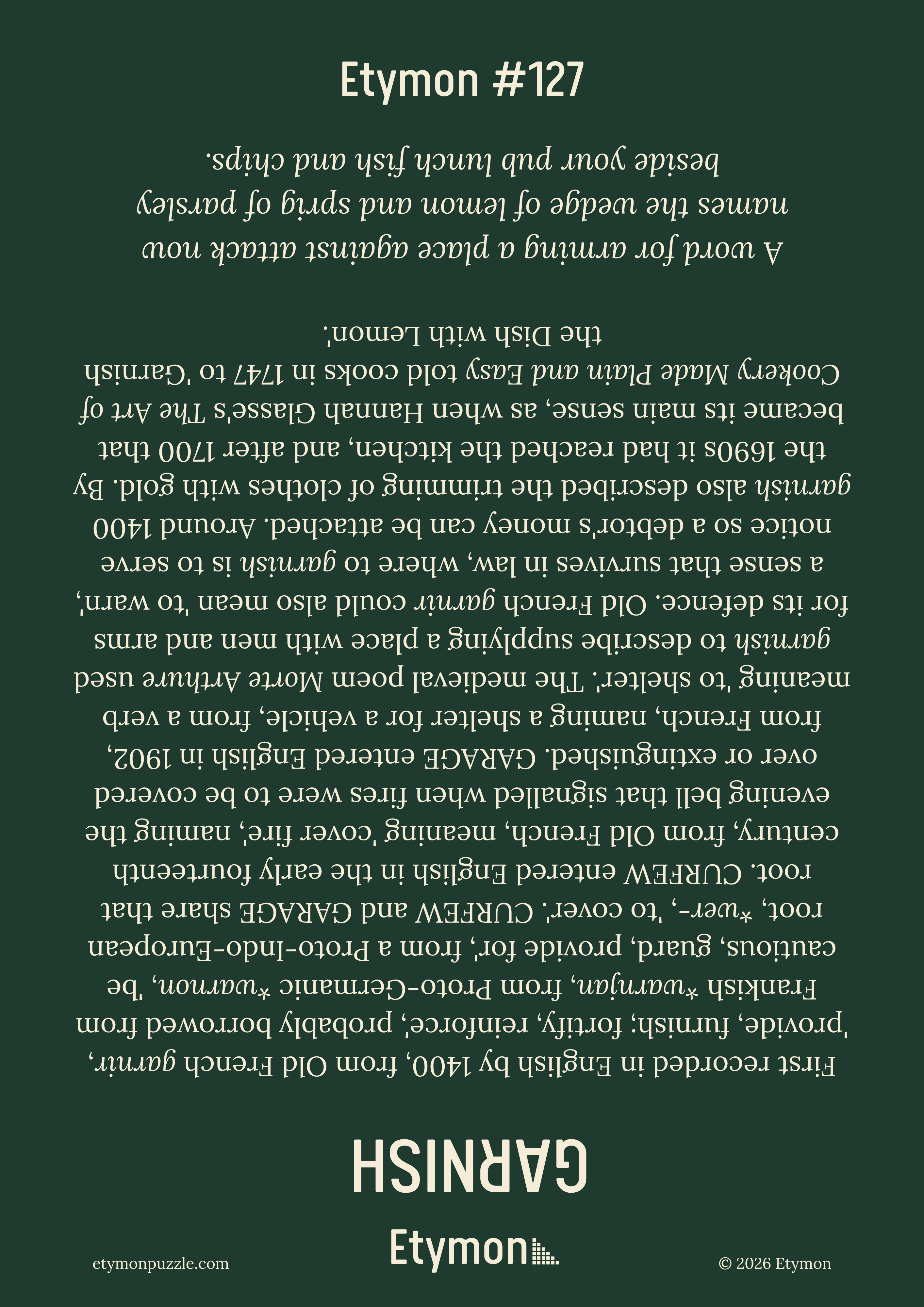
The word was in English by 1400, from Old French. Morte Arthure, a medieval poem about King Arthur’s wars, used it to describe supplying a place with men and arms for its defence.
Old French had the verb by the eleventh century, probably borrowed from the Germanic language of the Franks. In Old French it could also mean to warn.
Its Germanic ancestor meant 'to be cautious, or to guard', and traces to a Proto-Indo-European root, *wer-, meaning 'to cover'. The same root may also have given Old Irish its word for enclosed land.
CURFEW and GARAGE share the same root, meaning ‘to cover’. CURFEW entered English in the early fourteenth century, from Old French, meaning ‘cover fire’, naming the evening bell that signalled when fires were to be covered over or extinguished. GARAGE entered English in 1902, from French, naming a shelter for a vehicle, from a verb meaning ‘to shelter’.
Around 1400 it also described the trimming of clothes with gold. By the 1690s it had reached the kitchen, and after 1700 this use became its main sense. In 1747 Hannah Glasse's The Art of Cookery Made Plain and Easy used the word, instructing cooks to finish a dish with lemon before sending it to table.
Seven letters.
Answer Card
Flip your screen to read the Answer Card.
Enjoyed today’s Etymon puzzle?
Get The Classical Word Collection free.
Ten Etymon puzzle cards exploring the Greek and Latin roots of English, yours when you subscribe free to Etymon.
Share your Solved in N
Share where you solved this Etymon puzzle on Substack Notes.
Find your relevant Solved in N banner above and tap the Restack button (the two circular arrows) in the banner’s top-right corner. Your banner will open automatically in a new Substack Note, ready to post. Add a comment if you like (please avoid posting the answer directly), then tap Post.
How did you get on?
Share how many clues you needed to solve this Etymon puzzle in the comments below.
To preserve the solving experience for future puzzlers, please avoid posting the answer directly.