


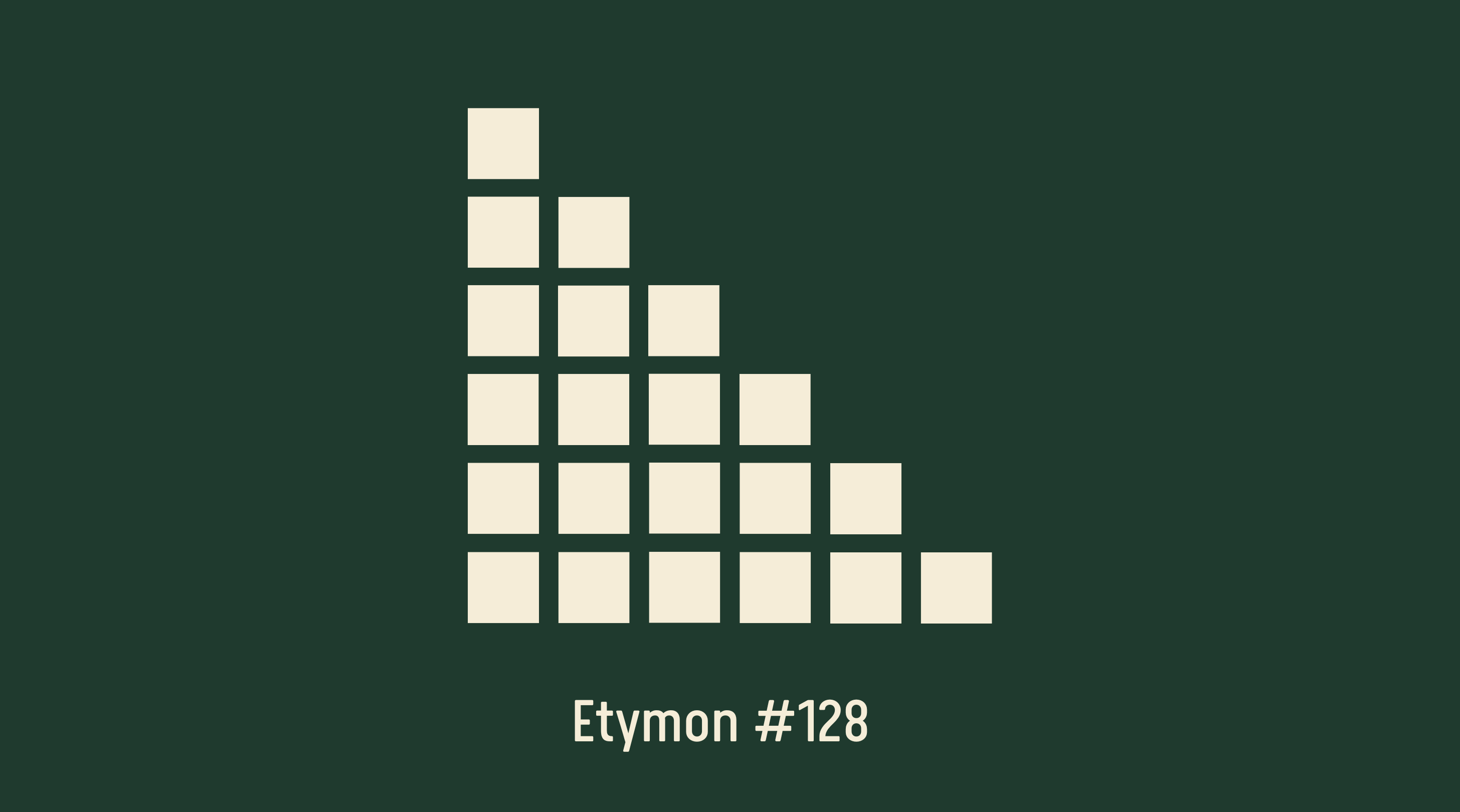
The word was first recorded in English around 1440, in a verse translation of Palladius's De re rustica, a Roman farming manual. It appears there among the arts, in a list with ethics and politics.
Two routes brought it into English. Latin, from Greek, used it in texts written in Britain around 1356, and Middle French, from Latin, had it around 1370. Early English spellings began with y or i, echoing the way Greek was then pronounced.
Its Greek source was built on the word for a steward, and in the New Testament it meant a steward's charge. The word for a steward joined two parts, whose Proto-Indo-European roots meant 'clan' and 'to assign, or allot'.
VILLAGE and NUMERAL each share one of those roots. VILLAGE entered English in the late fourteenth century, from Old French, describing a settlement smaller than a town. NUMERAL entered English from Latin in the late fourteenth century as an adjective, and became a noun in 1530, naming a number.
In 1577 a translator used the word to describe the way God governs the world, and in 1671 Milton employed it in the preface to Samson Agonistes for the structure of a play. By 1892 it named the system by which a nation produces and consumes goods. Then in 1958 a Winnipeg Free Press advertisement promoted it as a type of travel.
Seven letters.
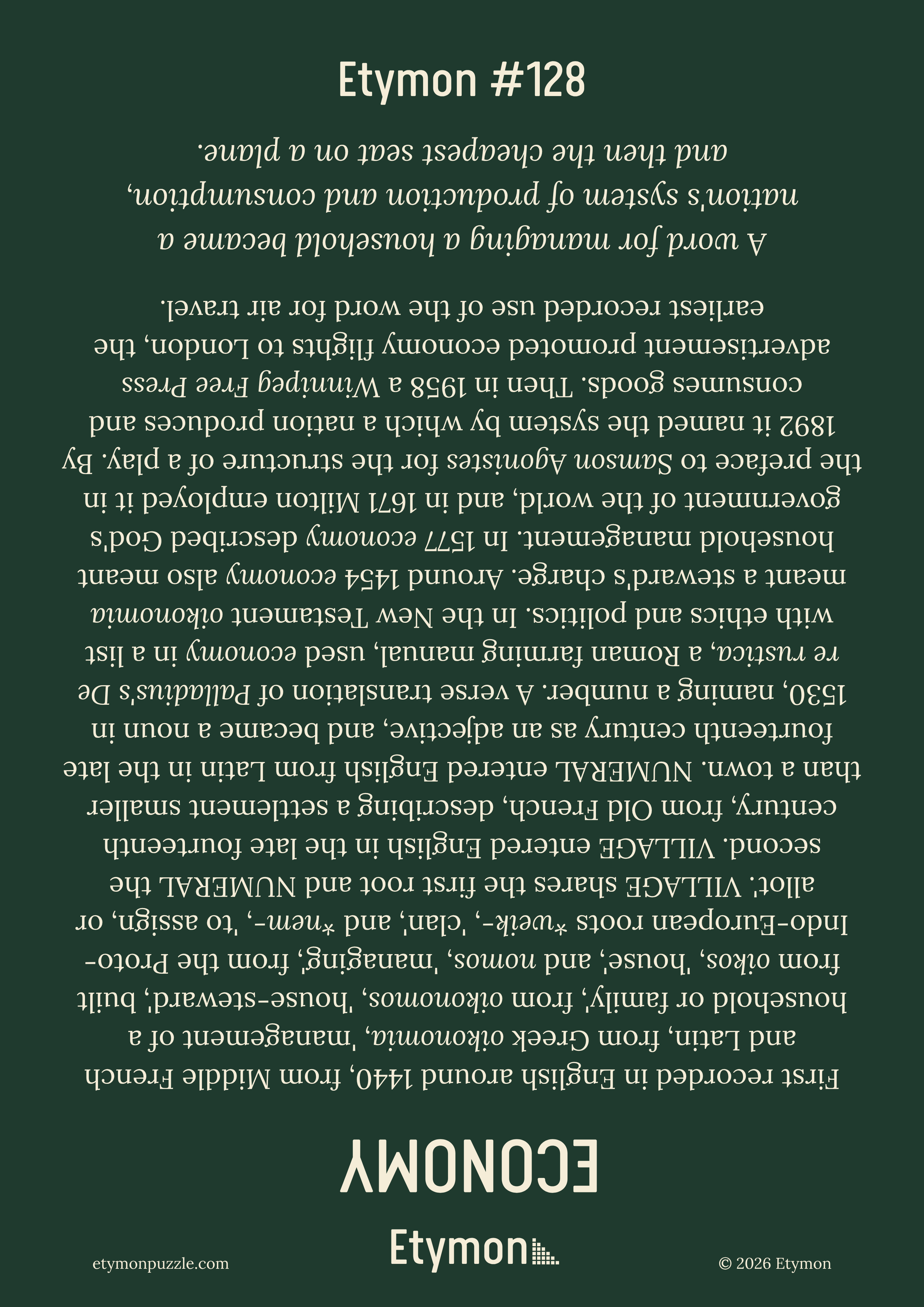
Answer Card
Flip your screen to read the Answer Card.
Enjoyed today’s Etymon puzzle?
Get The Classical Word Collection free.
Ten Etymon puzzle cards exploring the Greek and Latin roots of English, yours when you subscribe free to Etymon.
Share your Solved in N
Share where you solved this Etymon puzzle on Substack Notes.
Find your relevant Solved in N banner above and tap the Restack button (the two circular arrows) in the banner’s top-right corner. Your banner will open automatically in a new Substack Note, ready to post. Add a comment if you like (please avoid posting the answer directly), then tap Post.
How did you get on?
Share how many clues you needed to solve this Etymon puzzle in the comments below.
To preserve the solving experience for future puzzlers, please avoid posting the answer directly.