

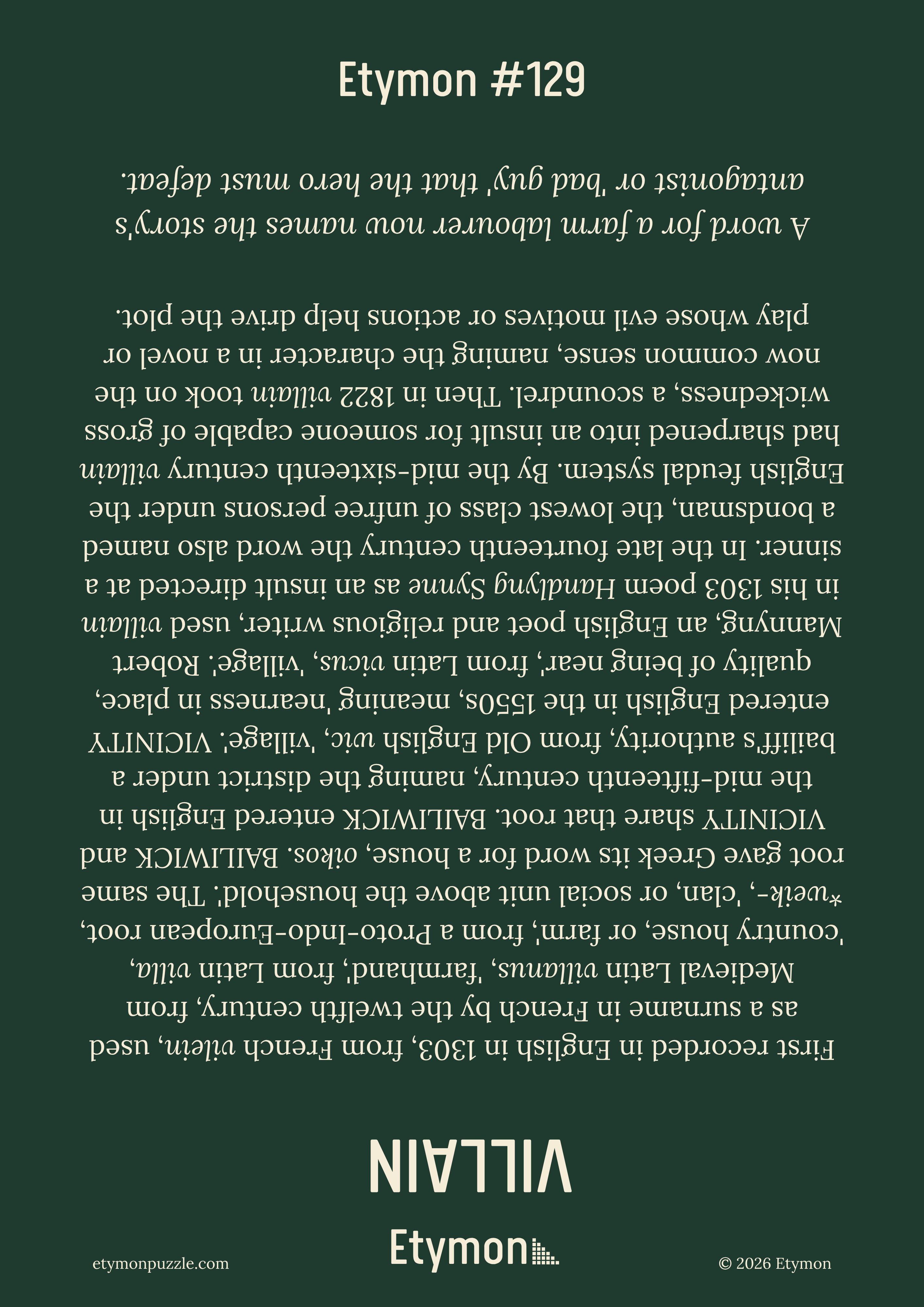
The word was first recorded in English in 1303, from French. Robert Mannyng, an English poet and religious writer, in his poem Handlyng Synne, used it as an insult directed at a sinner.
French had already used the word by the twelfth century, as a surname. Behind the French form lay a Latin word meaning 'farmhand', built from an earlier Latin word for a country house, or farm.
Behind that earlier Latin word lay a Proto-Indo-European root, *weik-, meaning 'clan, or social unit above the household'. The same root gave Greek its word for a house, oikos.
BAILIWICK and VICINITY both trace to a root meaning 'village, or settlement'. BAILIWICK entered English in the mid-fifteenth century, naming the district under a bailiff's authority, from Old English wic, 'village'. VICINITY entered English in the 1550s, from Latin, meaning 'nearness in place, quality of being near', from vicus, 'village'.
By the late fourteenth century the word also named a specific legal status, a bondsman, the lowest class of unfree persons under the English feudal system. By the mid-sixteenth century the word had sharpened into an insult for someone capable of gross wickedness, a scoundrel. In 1822 the word took on a new sense, naming the character in a novel or play whose evil motives or actions help drive the plot.
Seven letters.
Answer Card
Flip your screen to read the Answer Card.
Enjoyed today’s Etymon puzzle?
Get The Classical Word Collection free.
Ten Etymon puzzle cards exploring the Greek and Latin roots of English, yours when you subscribe free to Etymon.
Share your Solved in N
Share where you solved this Etymon puzzle on Substack Notes.
Find your relevant Solved in N banner above and tap the Restack button (the two circular arrows) in the banner’s top-right corner. Your banner will open automatically in a new Substack Note, ready to post. Add a comment if you like (please avoid posting the answer directly), then tap Post.
How did you get on?
Share how many clues you needed to solve this Etymon puzzle in the comments below.
To preserve the solving experience for future puzzlers, please avoid posting the answer directly.