


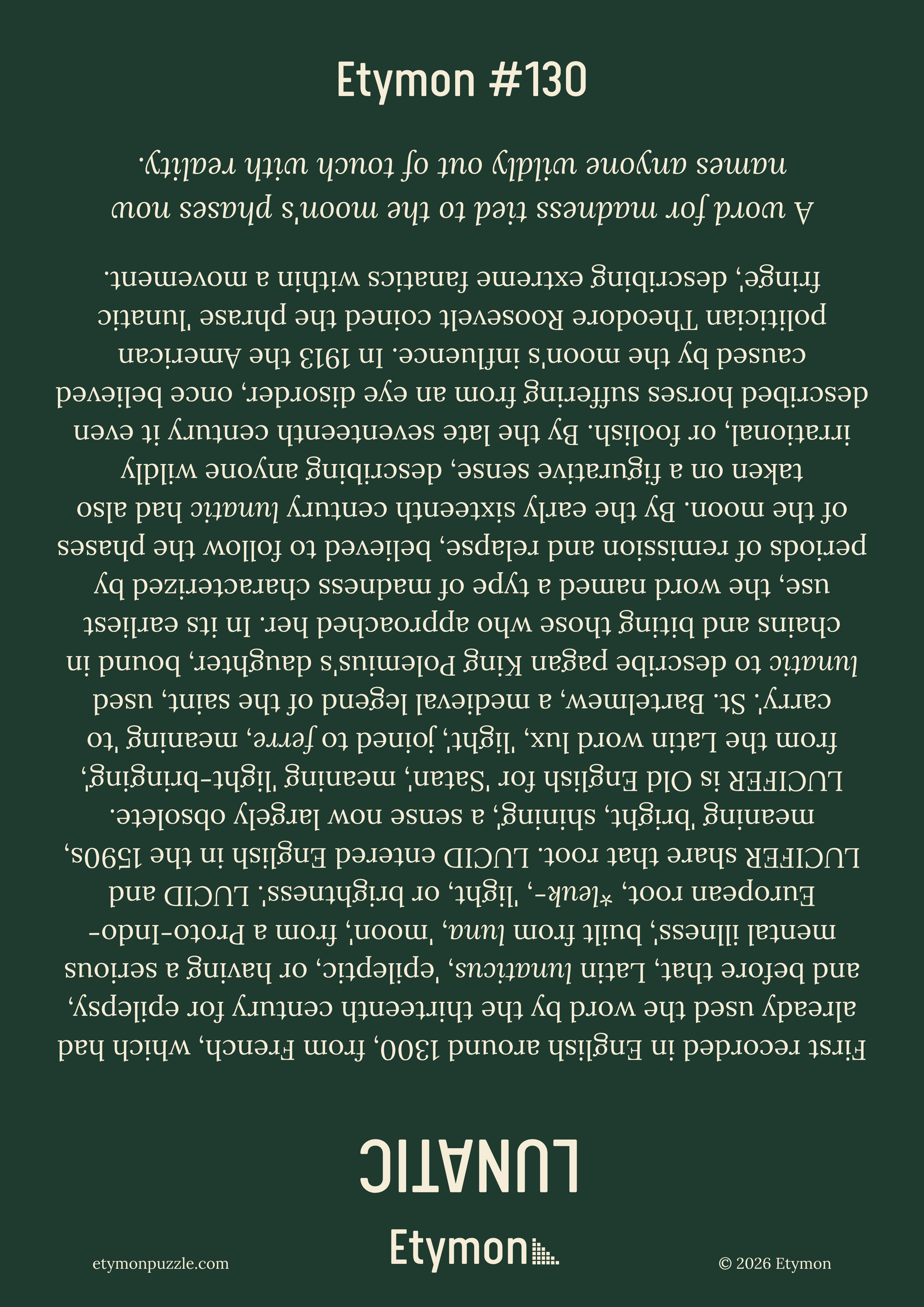
The word was first recorded in English around 1300, from French, and before that, Latin. St. Bartelmew, a medieval legend of the saint, described pagan King Polemius's daughter, bound in chains and biting those who approached her.
French had already used the word by the thirteenth century, to describe someone epileptic. Behind the French form lay a Latin word, also used in legal contexts to describe a person's state of mind, joined to a suffix that formed this Latin adjective.
Behind that Latin word lay the word for the moon, whose cyclical patterns, or phases, were believed to cause the condition the word describes. That word for the moon traces to a Proto-Indo-European root, *leuk-, meaning 'light, or brightness'.
LUCID and LUCIFER share the same root, meaning 'light, or brightness'. LUCID entered English in the 1590s, meaning 'bright, shining', a sense now largely obsolete, later coming to mean 'clear, free from obscurity'. LUCIFER is Old English for 'Satan', meaning 'light-bringing', from the Latin word lux, 'light', joined to a word meaning 'to carry'.
By the early sixteenth century the word had taken on a figurative sense, describing anyone wildly irrational, or foolish. Separately, by the late seventeenth century, it also described horses suffering from an eye disorder, once believed caused by the moon's influence. In 1913 the American politician Theodore Roosevelt used it, when he coined a phrase describing extreme fanatics within a movement.
Seven letters.
Answer Card
Flip your screen to read the Answer Card.
Enjoyed today’s Etymon puzzle?
Get The Classical Word Collection free.
Ten Etymon puzzle cards exploring the Greek and Latin roots of English, yours when you subscribe free to Etymon.
Share your Solved in N
Share where you solved this Etymon puzzle on Substack Notes.
Find your relevant Solved in N banner above and tap the Restack button (the two circular arrows) in the banner’s top-right corner. Your banner will open automatically in a new Substack Note, ready to post. Add a comment if you like (please avoid posting the answer directly), then tap Post.
How did you get on?
Share how many clues you needed to solve this Etymon puzzle in the comments below.
To preserve the solving experience for future puzzlers, please avoid posting the answer directly.
How many clues did you need for today's Etymon 🧩 I'd love to know how everyone got on 🤔