


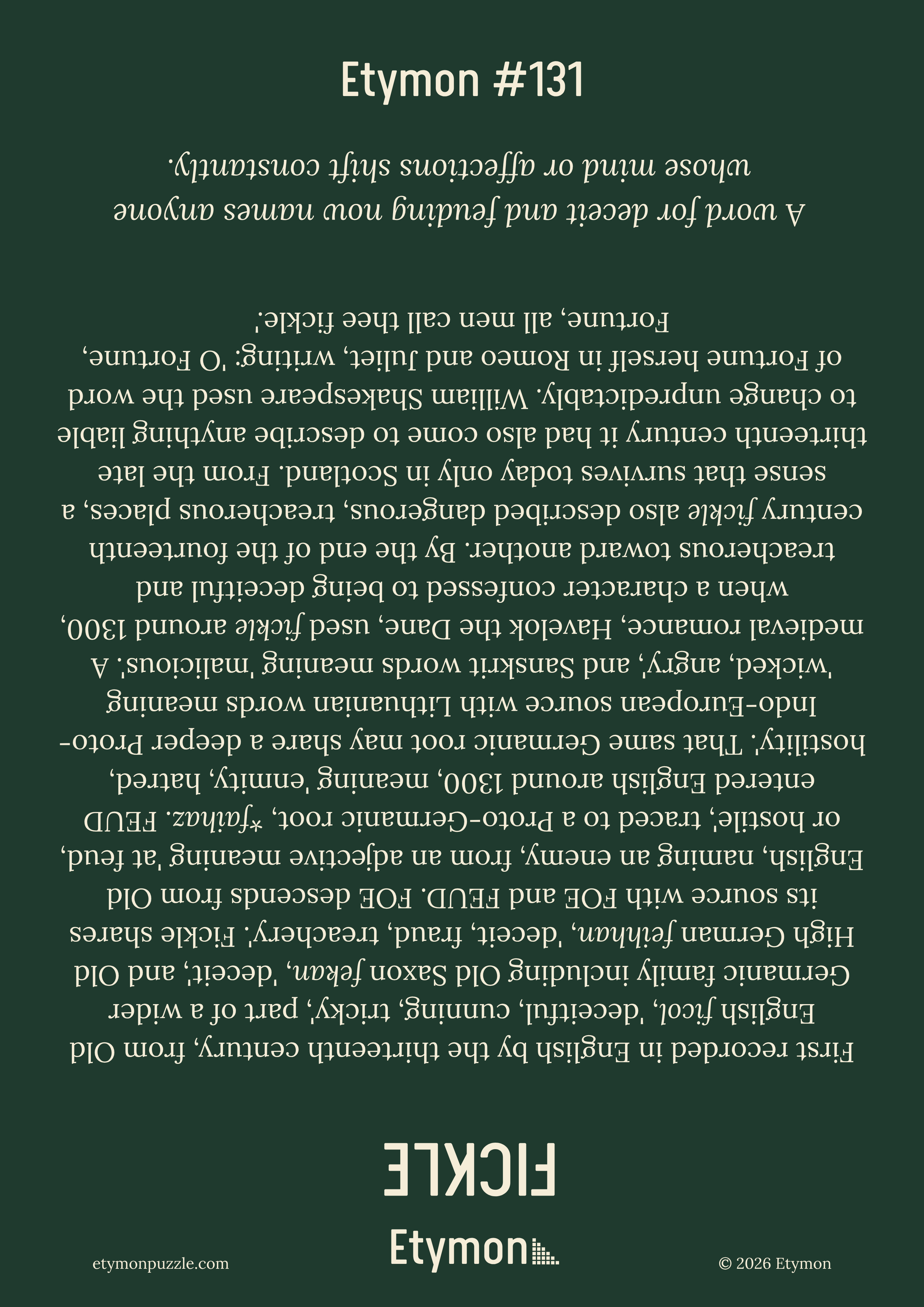
The word was first recorded in English by the thirteenth century, descended from an Old English word. A medieval romance used it when a character confessed to being deceitful and treacherous toward another.
Native to English, with no borrowing from French or Latin behind it. It belongs to a wider family of Germanic words, found also in Old Saxon and Old High German, all meaning 'deceit, or treachery'.
Behind that Old English word lay an adjective meaning 'at feud, or hostile'. That adjective traces to a Proto-Germanic root, *faihaz, which may share a deeper Proto-Indo-European source with Lithuanian words meaning 'wicked, angry', and Sanskrit words meaning 'malicious'.
FOE and FEUD share a Germanic root meaning 'hostile' or 'at feud'. FOE descends from Old English, where it named an enemy or adversary. FEUD entered English around 1300 as fede, meaning 'enmity, hatred, or hostility', only later coming to describe prolonged hostility between families or clans.
From the late thirteenth century the word came to describe anything liable to change unpredictably. Separately, by the end of the fourteenth century, it also described dangerous, treacherous places, a sense that survives today only in Scotland. William Shakespeare used the word in its changeable sense in Romeo and Juliet, writing that all men call Fortune by this name.
Six letters.
Answer Card
Flip your screen to read the Answer Card.
Enjoyed today’s Etymon puzzle?
Get The Classical Word Collection free.
Ten Etymon puzzle cards exploring the Greek and Latin roots of English, yours when you subscribe free to Etymon.
Share your Solved in N
Share where you solved this Etymon puzzle on Substack Notes.
Find your relevant Solved in N banner above and tap the Restack button (the two circular arrows) in the banner’s top-right corner. Your banner will open automatically in a new Substack Note, ready to post. Add a comment if you like (please avoid posting the answer directly), then tap Post.
How did you get on?
Share how many clues you needed to solve this Etymon puzzle in the comments below.