

The word was first recorded in English in 1531, from Latin. Hugh Latimer, an English clergyman, used it in a letter, doubting that the judges of his day were deeply confirmed in grace, or not capable of sin.
French had already used the word by the fifteenth century. Behind it lay a Late Latin adjective, built from a prefix meaning 'not', joined to a verb meaning 'to miss'.
The Latin verb is of uncertain origin. It may come from a lost word meaning 'having a defect in one's foot', and so once have meant 'to stumble'. That word would trace to a Proto-Indo-European root, *ped-, meaning 'foot'.
PAWN, the chess piece, and IMPEACH both entered English in the late fourteenth century, from Old French, and trace to a root meaning 'foot'. PAWN began as a foot soldier. IMPEACH comes from a Late Latin verb meaning 'to fetter'.
In 1620 Joseph Hall, a Doctor of Divinity, used the word in a book defending married clergy. He asked whether, if we honour a man, we must hold his pen to be incapable of error. By 1864 a treatise on logic used it to describe an argument that keeps every rule. Today it more commonly describes manners or taste that nobody could fault.
Ten letters.
Answer Card
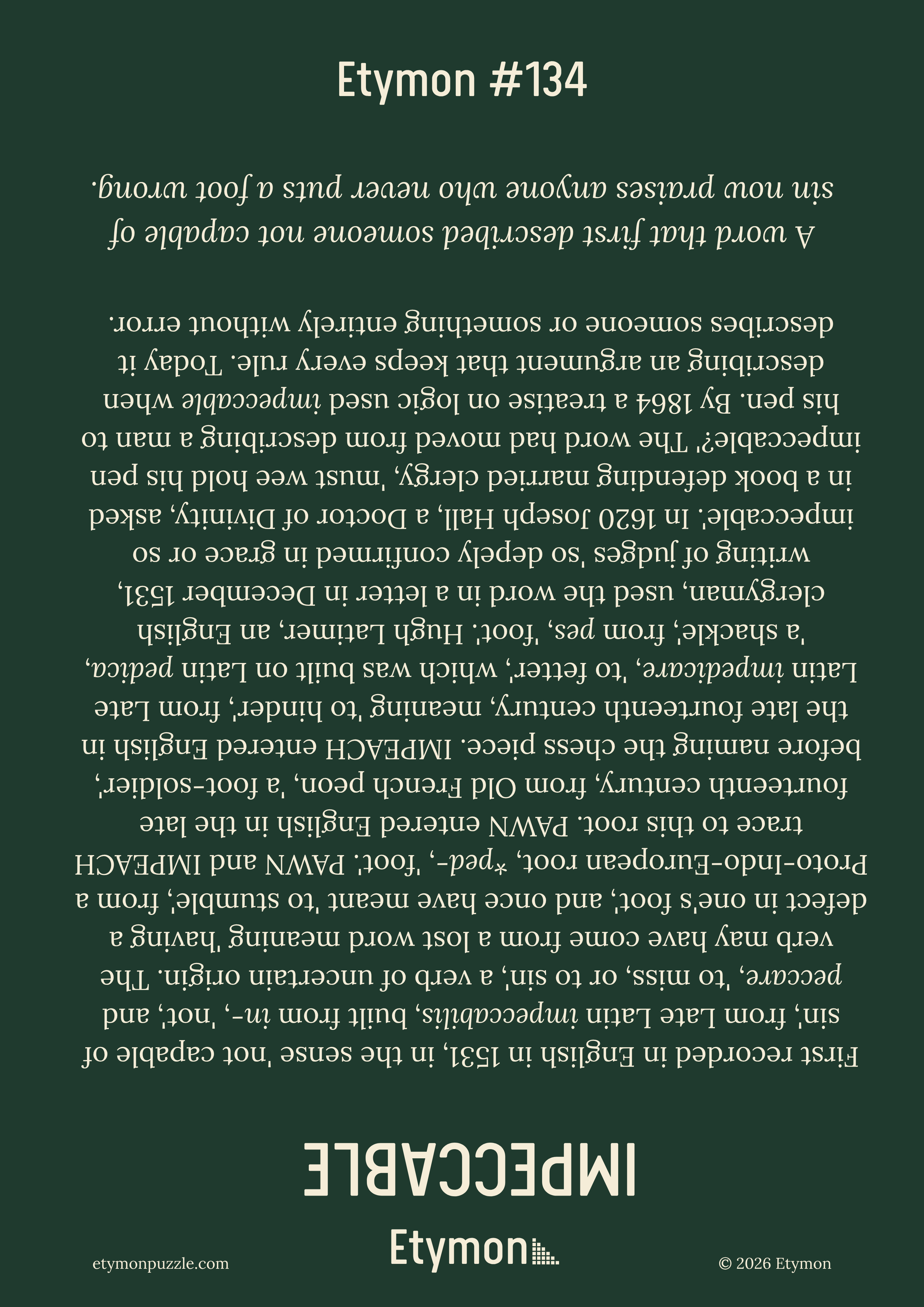
Flip your screen to read the Answer Card.
Enjoyed today’s Etymon puzzle?
Get The Classical Word Collection free.
Ten Etymon puzzle cards exploring the Greek and Latin roots of English, yours when you subscribe free to Etymon.
Share your Solved in N
Share where you solved this Etymon puzzle on Substack Notes.
Find your relevant Solved in N banner above and tap the Restack button (the two circular arrows) in the banner’s top-right corner. Your banner will open automatically in a new Substack Note, ready to post. Add a comment if you like (please avoid posting the answer directly), then tap Post.
How did you get on?
Share how many clues you needed to solve this Etymon puzzle in the comments below.