


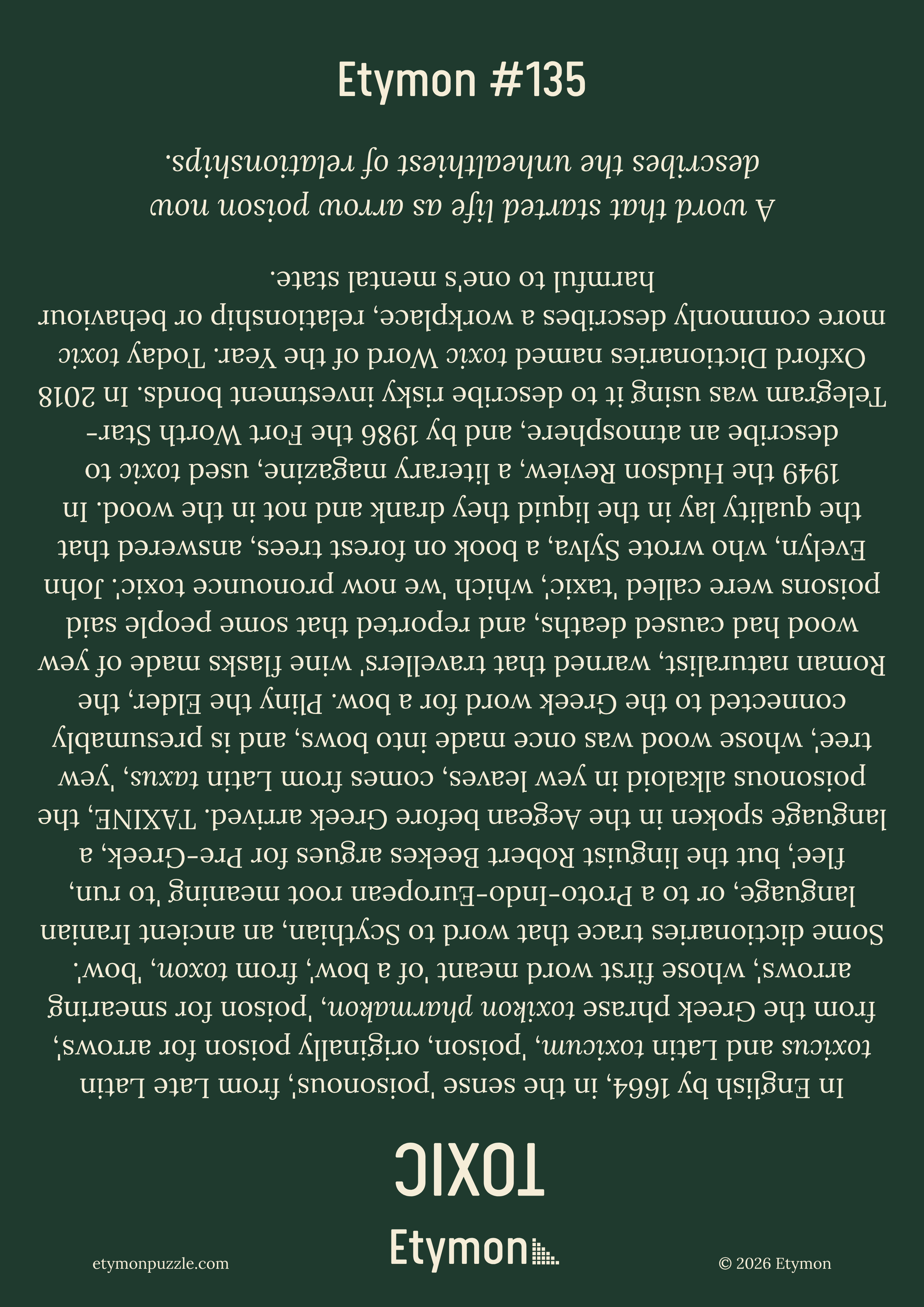
The word was in English by 1664, from Latin. John Evelyn, in Sylva, his book on forest trees, quoted the Roman naturalist Pliny's warning against travellers' wine flasks made of a particular wood. Evelyn used the word for what lay in the liquid and not in the wood.
French had already used the word by the twelfth century. Late Latin used it figuratively in the sixth century, and literally only in the ninth. In 1601 English met the older Latin noun in Philemon Holland's translation of Pliny's encyclopedia of the natural world.
The Latin noun came from a Greek phrase for a substance smeared on arrows, whose first word meant 'of a bow'. Some dictionaries trace the Greek word for a bow to Scythian, and one suggests a Proto-Indo-European root meaning 'to run, flee'. An etymological dictionary of Greek disagrees, since words built on the Greek word already appear in Mycenaean Greek, and argues for a Pre-Greek origin.
TAXINE, the poison in yew leaves, was in English by 1907, from Latin taxus, 'yew tree', whose wood was once made into bows. That Latin word is thought to be connected to the Greek word for a bow.
In 1949 the Hudson Review used it to describe an atmosphere. By 1986 the Fort Worth Star-Telegram was using it to describe risky investment bonds. In 2018 Oxford Dictionaries named it Word of the Year. Today it more commonly describes a workplace, relationship or behaviour harmful to one's mental state.
Five letters.
Answer Card
Flip your screen to read the Answer Card.
Enjoyed today’s Etymon puzzle?
Get The Classical Word Collection free.
Ten Etymon puzzle cards exploring the Greek and Latin roots of English, yours when you subscribe free to Etymon.
Share your Solved in N
Share where you solved this Etymon puzzle on Substack Notes.
Find your relevant Solved in N banner above and tap the Restack button (the two circular arrows) in the banner’s top-right corner. Your banner will open automatically in a new Substack Note, ready to post. Add a comment if you like (please avoid posting the answer directly), then tap Post.
How did you get on?
Share how many clues you needed to solve this Etymon puzzle in the comments below.
Argh, I should have gotten this in three, because I studied this word and its relatives exactly a year ago, but I just couldn't remember the Greek word for bow. That was a cleverly-paced series of clues. :-)