The word was in English by about 1450, from Latin. A Middle English translator of Boccaccio's Latin book on famous women used it to mean what he had done with the goddesses on the page, in the same order as the original.
Latin gave English the word, and French had already used it by the thirteenth century. In the Latin Bible, the verb behind it appears when Caesar Augustus orders a census, and the whole world is to be enrolled.
The Latin verb was built from a prefix meaning 'down', joined to a verb meaning 'to write'. That verb traces to a Proto-Indo-European root meaning 'to cut', which may also lie behind a Greek verb for scratching an outline.
SCRIPT and SHRIFT share a root meaning 'to cut'. SCRIPT entered English in the late fourteenth century, from Latin scriptum, 'a writing', originally as marks carved in stone or wood. SHRIFT, as in 'short shrift', descends from Old English scrift, 'confession to a priest', borrowed early from the same Latin verb.
In 1538 Thomas Elyot's dictionary used it to mean drawing lines with a rod. In 1913 the American poet Ezra Pound reminded other poets that the painter can capture landscapes much better than they can. Today it is more commonly used to say what a person, place or thing is like.
Eight letters.
Answer Card
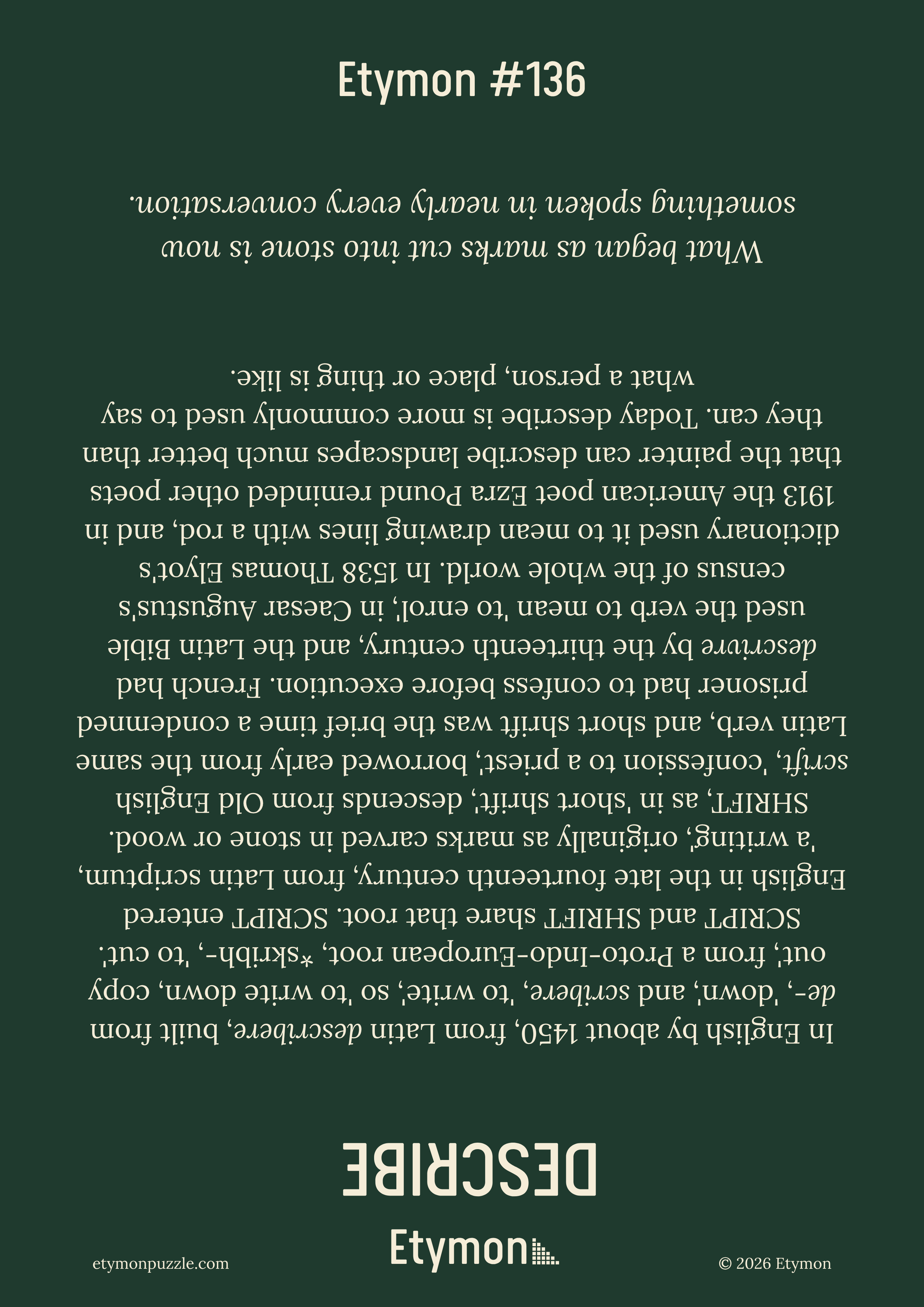
Flip your screen to read the Answer Card.
Enjoyed today’s Etymon puzzle?
Get The Classical Word Collection free.
Ten Etymon puzzle cards exploring the Greek and Latin roots of English, yours when you subscribe free to Etymon.
Plus a new Etymon puzzle every day — free Monday to Friday.
Share your Solved in N
Share where you solved this Etymon puzzle on Substack Notes.
Find your relevant Solved in N banner above and tap the Restack button (the two circular arrows) in the banner’s top-right corner. Your banner will open automatically in a new Substack Note, ready to post. Add a comment if you like (please avoid posting the answer directly), then tap Post.
How did you get on?
Share how many clues you needed to solve this Etymon puzzle in the comments below.