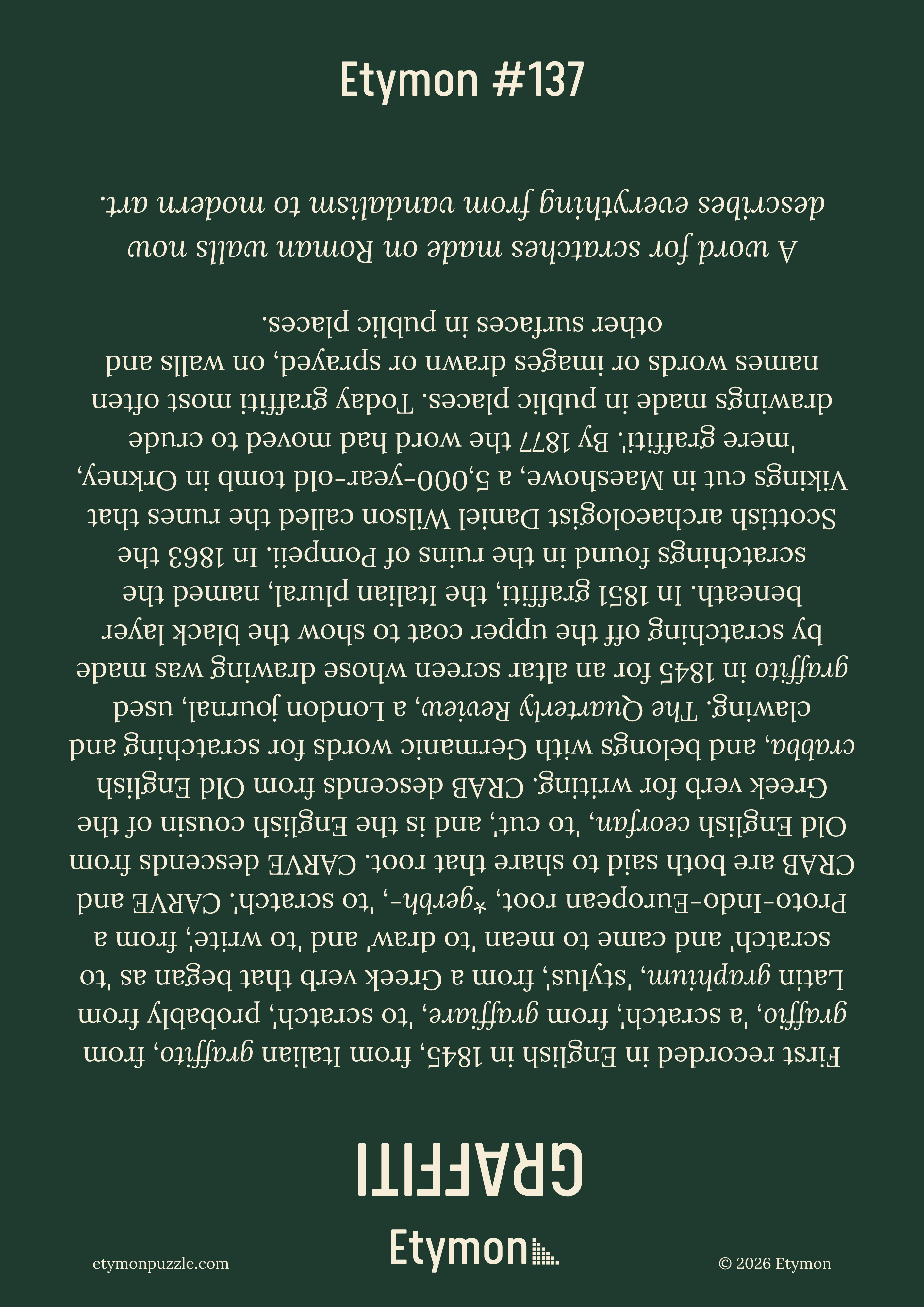
First recorded in English in 1845, in the singular, in the Quarterly Review, a London journal of essays and reviews. The reviewer described an altar screen whose drawing was made by scratching off the upper coat to show the black layer beneath. This word is the plural.
Italian was using a verb for scratching by the thirteenth century and a noun for the scratch by the fourteenth. Behind them, probably, lay the Latin word for a stylus, the pencil of the ancient world. English later borrowed the noun's smaller form.
In Greek, the source verb began as 'to scratch', the way a stylus marks a clay tablet. From the scratch came 'to draw', and then 'to write'. The verb itself goes back to a Proto-Indo-European root, *gerbh-, whose descendants reach English by a second road, through the Germanic languages.
CARVE and CRAB are both said to trace to a root meaning 'to scratch'. CARVE descends from Old English ceorfan, 'to cut', and is the English cousin of the Greek verb for writing. CRAB descends from Old English crabba, and belongs with Germanic words for scratching and clawing.
In 1851 it named the scratchings found in the ruins of Pompeii. In 1863 the Scottish archaeologist Daniel Wilson gave the same name to runes that Vikings cut in the twelfth century inside Maeshowe, a 5,000-year-old tomb in Orkney. By 1877 it had moved to crude drawings made in public places. In 1992 the Economist, writing of the footballer Kevin Keegan's standing on Tyneside, quoted an old example: 'Jesus saves, but Keegan scores on the rebound'.
Eight letters.
Answer Card
Flip your screen to read the Answer Card.
Enjoyed today’s Etymon puzzle?
Get The Classical Word Collection free.
Ten Etymon puzzle cards exploring the Greek and Latin roots of English, yours when you subscribe free to Etymon.
Plus a new Etymon puzzle every day — free Monday to Friday.
Share your Solved in N
Share where you solved this Etymon puzzle on Substack Notes.
Find your relevant Solved in N banner above and tap the Restack button (the two circular arrows) in the banner’s top-right corner. Your banner will open automatically in a new Substack Note, ready to post. Add a comment if you like (please avoid posting the answer directly), then tap Post.
How did you get on?
Share how many clues you needed to solve this Etymon puzzle in the comments below.