


The word was first recorded in English around 1320, from French. In 1597 the first printed edition of Shakespeare's Romeo and Juliet used it to describe the ringing of a bell.
French had already used the word by 1285, in a London statute that named the church of St Martin le Grand. It began as an order, with the verb first and the noun after.
The verb meant 'to cover'. It came through Latin from a Proto-Indo-European root, *wer-, which meant the same. That root may also lie behind a Sanskrit word for an enclosure.
KERCHIEF and FOCUS each share one half of this word. KERCHIEF entered English in the early 1200s, from French, naming a cloth worn on the head. FOCUS entered English in the 1640s, from Latin, where it meant a hearth.
By 1569 the chronicler Richard Grafton used it for the bell William the Conqueror was said to have ordered rung in every town. In 1751 Thomas Gray opened his Elegy with it tolling for the end of the day. Today it more commonly describes a time after which people should be home.
Six letters.
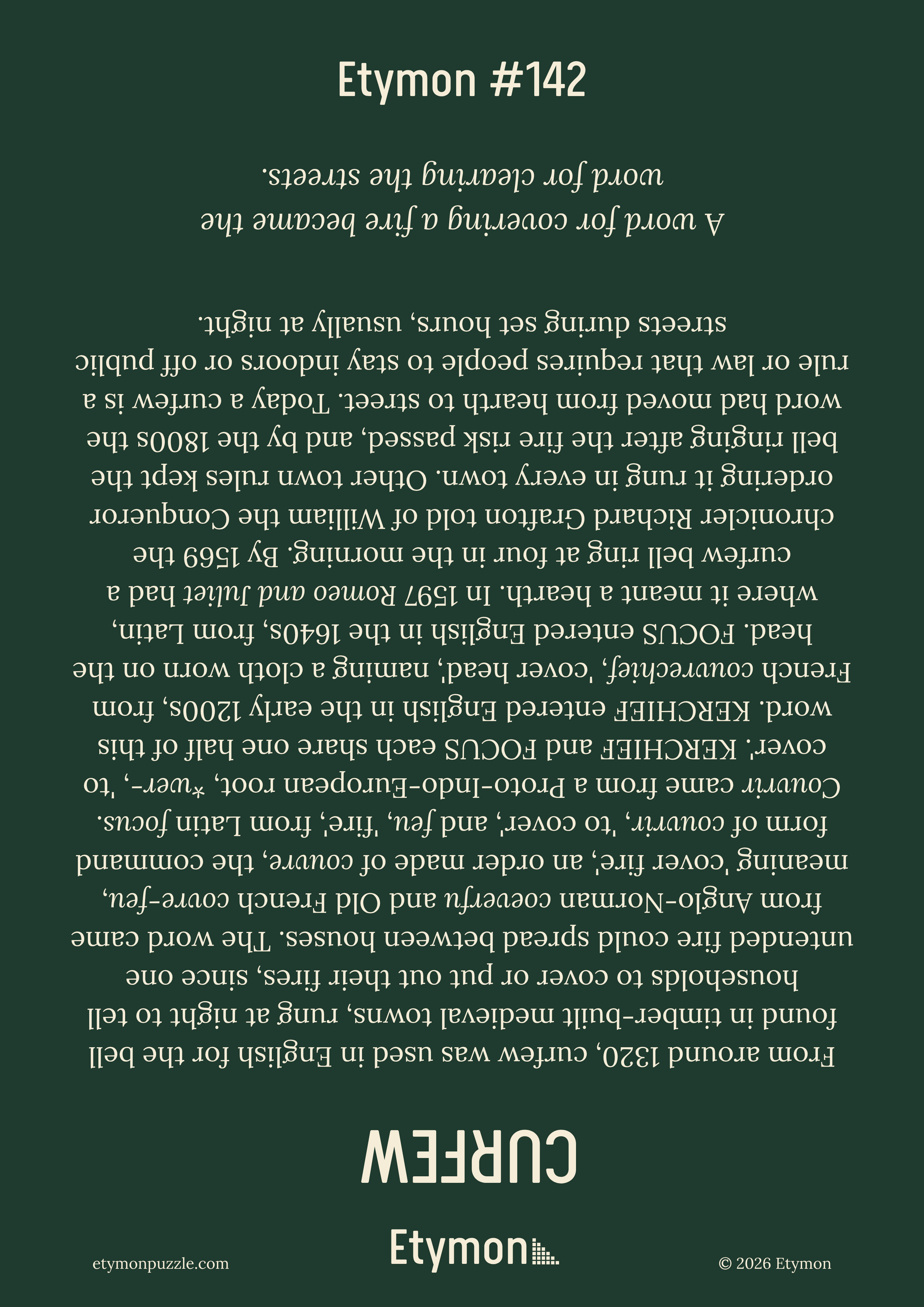
Answer Card
Flip your screen to read the Answer Card.
Enjoyed today’s Etymon puzzle?
Get The Classical Word Collection free.
Ten Etymon puzzle cards exploring the Greek and Latin roots of English, yours when you subscribe free to Etymon.
Share your Solved in N
Share where you solved this Etymon puzzle on Substack Notes.
Find your relevant Solved in N banner above and tap the Restack button (the two circular arrows) in the banner’s top-right corner. Your banner will open automatically in a new Substack Note, ready to post. Add a comment if you like (please avoid posting the answer directly), then tap Post.
How did you get on?
Share how many clues you needed to solve this Etymon puzzle in the comments below.
Only got it in 5, sadly...
solved in 4!!! surprised and chuffed!!