


The word was first recorded in English by 1400, from Latin. It appears in a translation of the Milanese surgeon Lanfranc's Science of Cirurgie, describing small pricks that some surgeons make on a patient in the form of a cross. That sense is now obsolete.
Latin had already used the word by the early thirteenth century, in texts written in Britain, and English took it straight from Latin. In 1609 the composer John Dowland translated a Latin treatise on music and used it for a division marked by a dot.
Behind the word lay a Latin noun for an act of stabbing, built on a verb meaning to pierce. That verb comes from a Proto-Indo-European root, *peuk-, meaning 'to prick', shared with Latin pugnus, 'fist', and possibly with Greek pygme, 'fist, boxing'.
POUNCE and POIGNANT share the same root. POUNCE meant a hawk's claw by the late fifteenth century, probably from Old French. POIGNANT entered English in the late fourteenth century, from Old French, for a sauce or a feeling that hurts.
In 1954 T. S. Eliot's play The Confidential Clerk used it in a greeting, 'there you are, Eggerson! ... as always'. In 1997 the magazine Rail listed it among 'the basics' of a railway, alongside clean trains and sensible prices.
Eight letters.
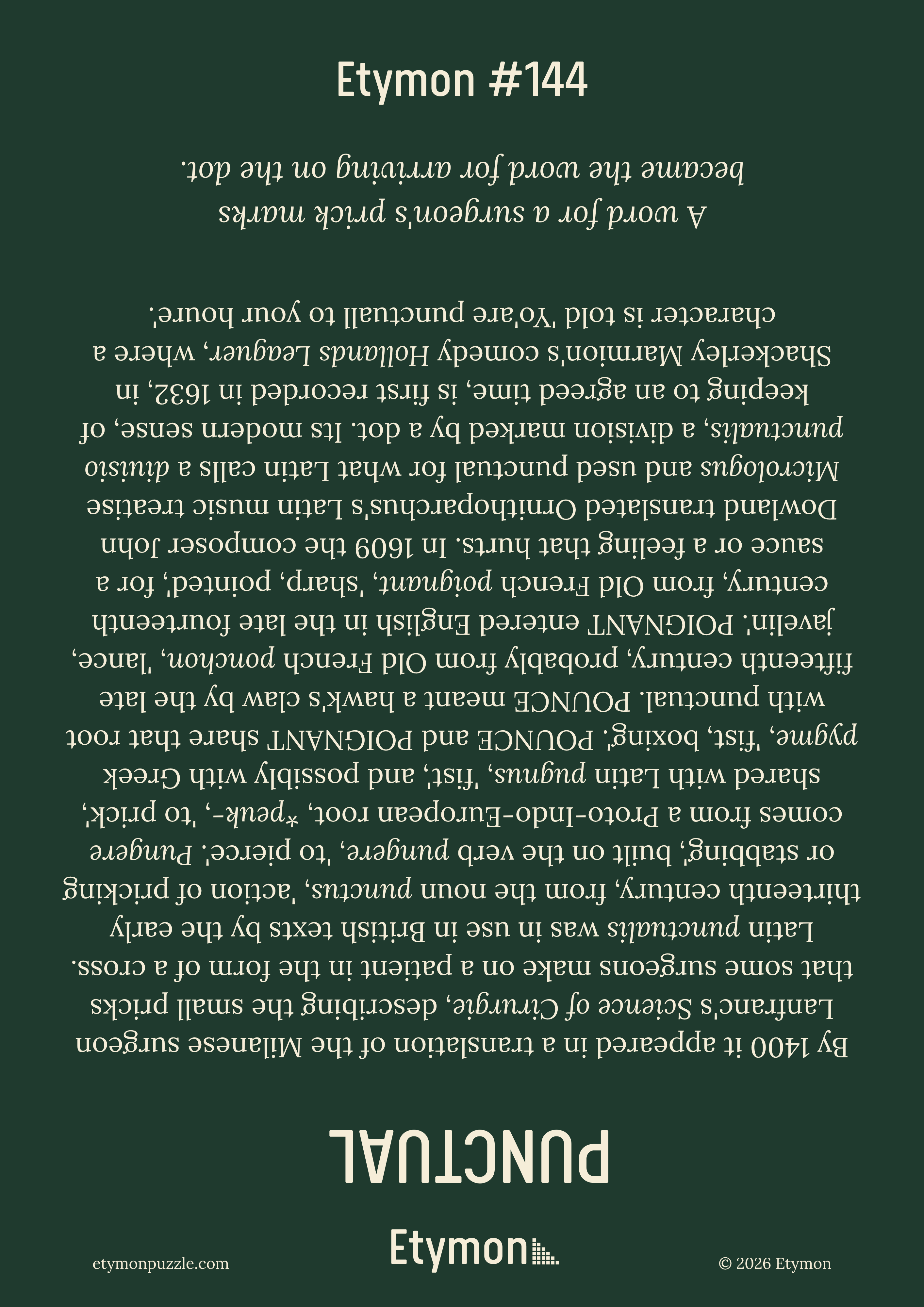
Answer Card
Flip your screen to read the Answer Card.
Enjoyed today’s Etymon puzzle?
Get The Classical Word Collection free.
Ten Etymon puzzle cards exploring the Greek and Latin roots of English, yours when you subscribe free to Etymon.
Share your Solved in N
Share where you solved this Etymon puzzle on Substack Notes.
Find your relevant Solved in N banner above and tap the Restack button (the two circular arrows) in the banner’s top-right corner. Your banner will open automatically in a new Substack Note, ready to post. Add a comment if you like (please avoid posting the answer directly), then tap Post.
How did you get on?
Share how many clues you needed to solve this Etymon puzzle in the comments below.