


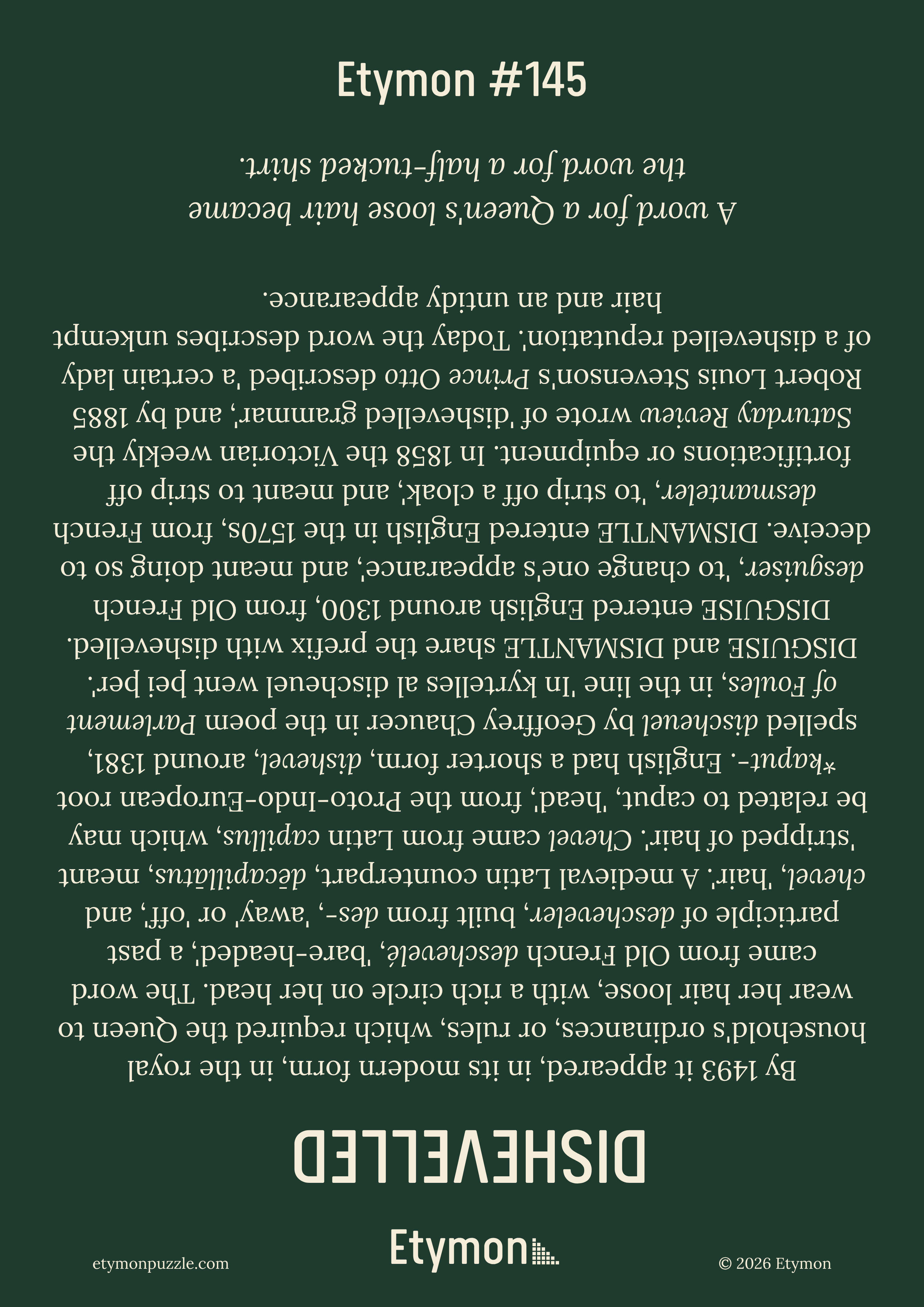
The word was first recorded in English, in its modern form, by 1493, from Old French. It appears in that year's ordinances, or rules, for the royal household, which required the Queen to wear her hair in a particular way, with a rich circle on her head.
French had already used the word by the early fourteenth century, to describe someone bare-headed. English had a shorter form used around 1381, in Geoffrey Chaucer's Parlement of Foules, a poem about a gathering of birds, before adding an ending of its own.
In Old French, the source verb was built on the word for hair, and a medieval Latin counterpart meant 'stripped of hair'. The Latin word for hair may be related to the one for head, from a Proto-Indo-European root, *kaput-, meaning 'head'.
DISGUISE and DISMANTLE share a prefix with this word, dis-, meaning 'away' or 'off'. DISGUISE entered English around 1300, from Old French, meaning to change one's appearance to deceive. DISMANTLE entered English in the 1570s, from French, meaning to strip off fortifications or equipment, and the French word behind it meant to strip off a cloak.
By 1858 the Victorian weekly the Saturday Review used the word for a style of grammar. In 1885 the Scottish writer Robert Louis Stevenson's novel Prince Otto used it to describe a lady's reputation. Today it is more commonly used for a particular look.
Eight letters.
Answer Card
Flip your screen to read the Answer Card.
Enjoyed today’s Etymon puzzle?
Get The Classical Word Collection free.
Ten Etymon puzzle cards exploring the Greek and Latin roots of English, yours when you subscribe free to Etymon.
Share your Solved in N
Share where you solved this Etymon puzzle on Substack Notes.
Find your relevant Solved in N banner above and tap the Restack button (the two circular arrows) in the banner’s top-right corner. Your banner will open automatically in a new Substack Note, ready to post. Add a comment if you like (please avoid posting the answer directly), then tap Post.
How did you get on?
Share how many clues you needed to solve this Etymon puzzle in the comments below.