
The word was first recorded in English by 1552, from Latin. The poet and antiquarian John Leland used it to describe a linguistic element being rejected.
Latin passed the word directly into English. It was built from a prefix meaning 'out', joined to a second element.
Behind that second element lay a Latin verb meaning 'to clap'. The deeper origin of that verb remains unknown, with no confirmed root beyond Latin.
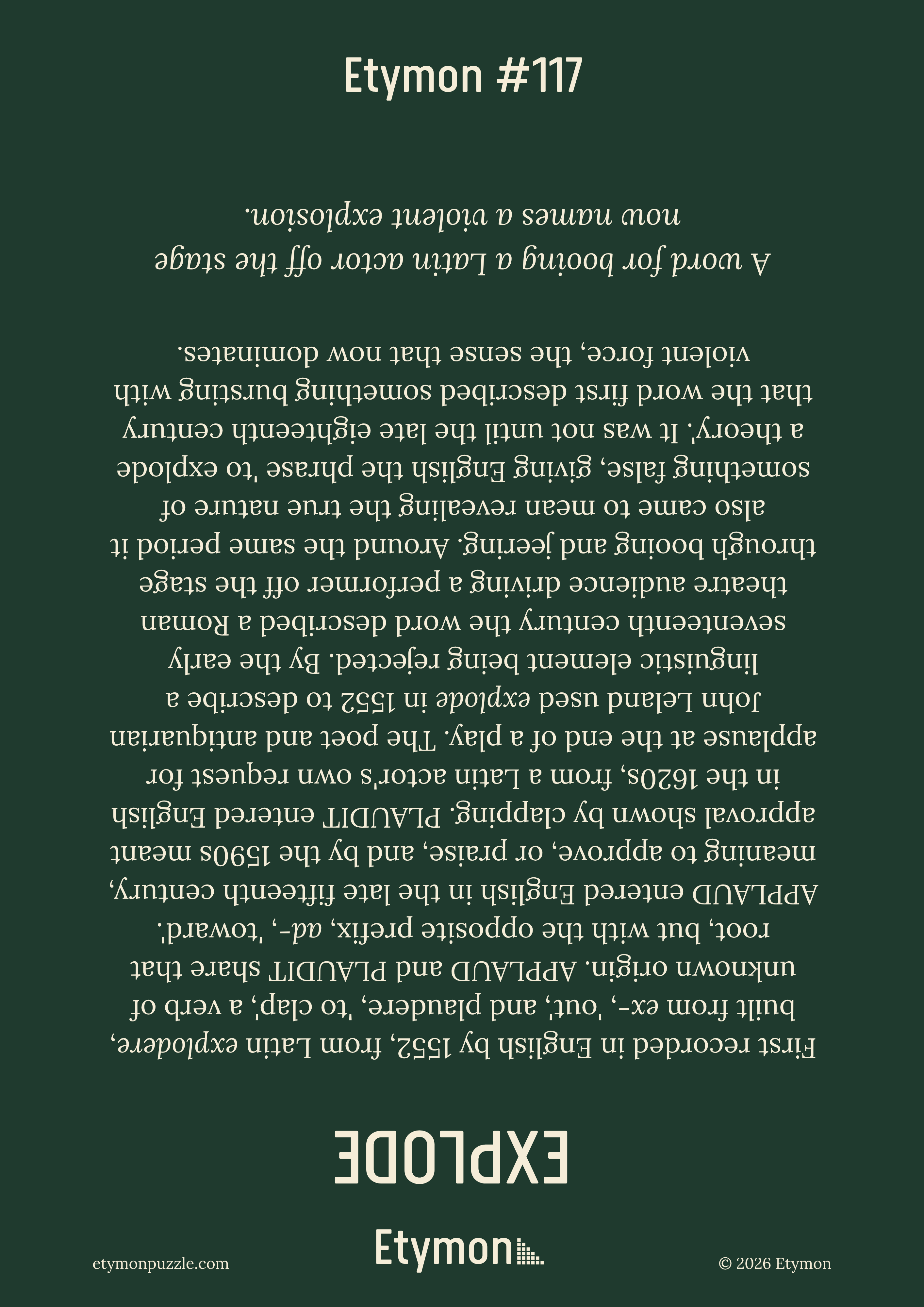
APPLAUD and PLAUDIT share the same root, but with the opposite prefix, meaning 'toward' rather than 'out'. APPLAUD entered English in the late fifteenth century, meaning to approve, or praise. By the 1590s, specifically, it meant approval shown by clapping. PLAUDIT entered English in the 1620s, from a Latin actor's own request for applause at the end of a play.
By the early seventeenth century the word described an audience driving a performer off the stage through booing and jeering. Around the same period it also came to mean revealing the true nature of something false, or discrediting a theory once believed true. It was not until the late eighteenth century that the word first described something bursting with a force.
Seven letters.
Answer Card
Flip your screen to read the Answer Card.
Enjoyed today’s Etymon puzzle?
Get The Classical Word Collection free.
Ten Etymon puzzle cards exploring the Greek and Latin roots of English, yours when you subscribe free to Etymon.

Share your Solved in N
Share where you solved today’s Etymon on Substack Notes without giving the answer away.
Find your relevant Solved in N banner above and tap the Restack button (the two circular arrows) in the banner’s top-right corner. Your banner will open automatically in a new Substack Note, ready to post.
Add a comment if you like, then tap Post.
Puzzle comments
Comments are a shared space for solving approaches, clue interpretations, historical observations, cognate discussions, and partial pathways through the puzzle.
To preserve the solving experience for future puzzlers, please avoid posting the answer directly. See full Commenting Guidelines.