
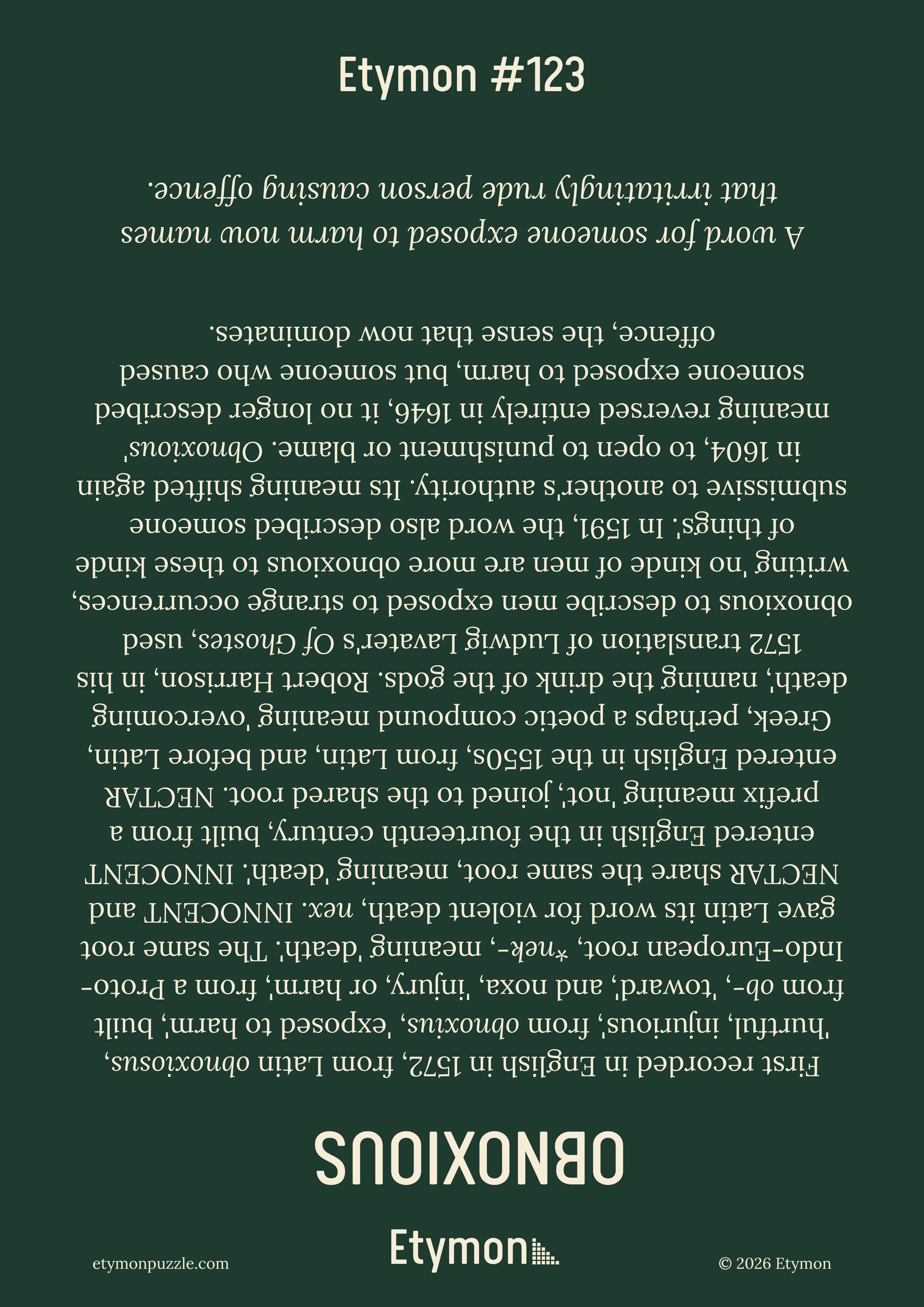
The word was first recorded in English in 1572, from Latin. Robert Harrison, in his translation of Ludwig Lavater's Of Ghostes, used it to describe men who were exposed to strange occurrences.
Latin gave English the word directly, without passing through French. It was built from a prefix meaning 'toward', joined to a noun meaning 'injury, or harm'.
That Latin noun for injury traces to a Proto-Indo-European root, *nek-, meaning 'death'. The same root gave Latin its word for violent death, or murder.
INNOCENT and NECTAR share the same root, meaning 'death'. INNOCENT entered English in the fourteenth century, built from a prefix meaning 'not', joined to the shared root. NECTAR entered English in the 1550s, from Latin, and before Latin, Greek, perhaps a poetic compound meaning 'overcoming death', naming the drink of the gods.
In 1591 the word had also come to describe someone submissive, or obedient, to another's authority. In 1604 it also meant open to punishment or blame. By 1646 the word's meaning had reversed, describing someone who gives offence.
Nine letters.
Answer Card
Flip your screen to read the Answer Card.
Enjoyed today’s Etymon puzzle?
Get The Classical Word Collection free.
Ten Etymon puzzle cards exploring the Greek and Latin roots of English, yours when you subscribe free to Etymon.
Share your Solved in N
Share where you solved today’s Etymon on Substack Notes without giving the answer away.
Find your relevant Solved in N banner above and tap the Restack button (the two circular arrows) in the banner’s top-right corner. Your banner will open automatically in a new Substack Note, ready to post.
Add a comment if you like, then tap Post.
Puzzle comments
Comments are a shared space for solving approaches, clue interpretations, historical observations, cognate discussions, and partial pathways through the puzzle.
To preserve the solving experience for future puzzlers, please avoid posting the answer directly. See full Commenting Guidelines.