

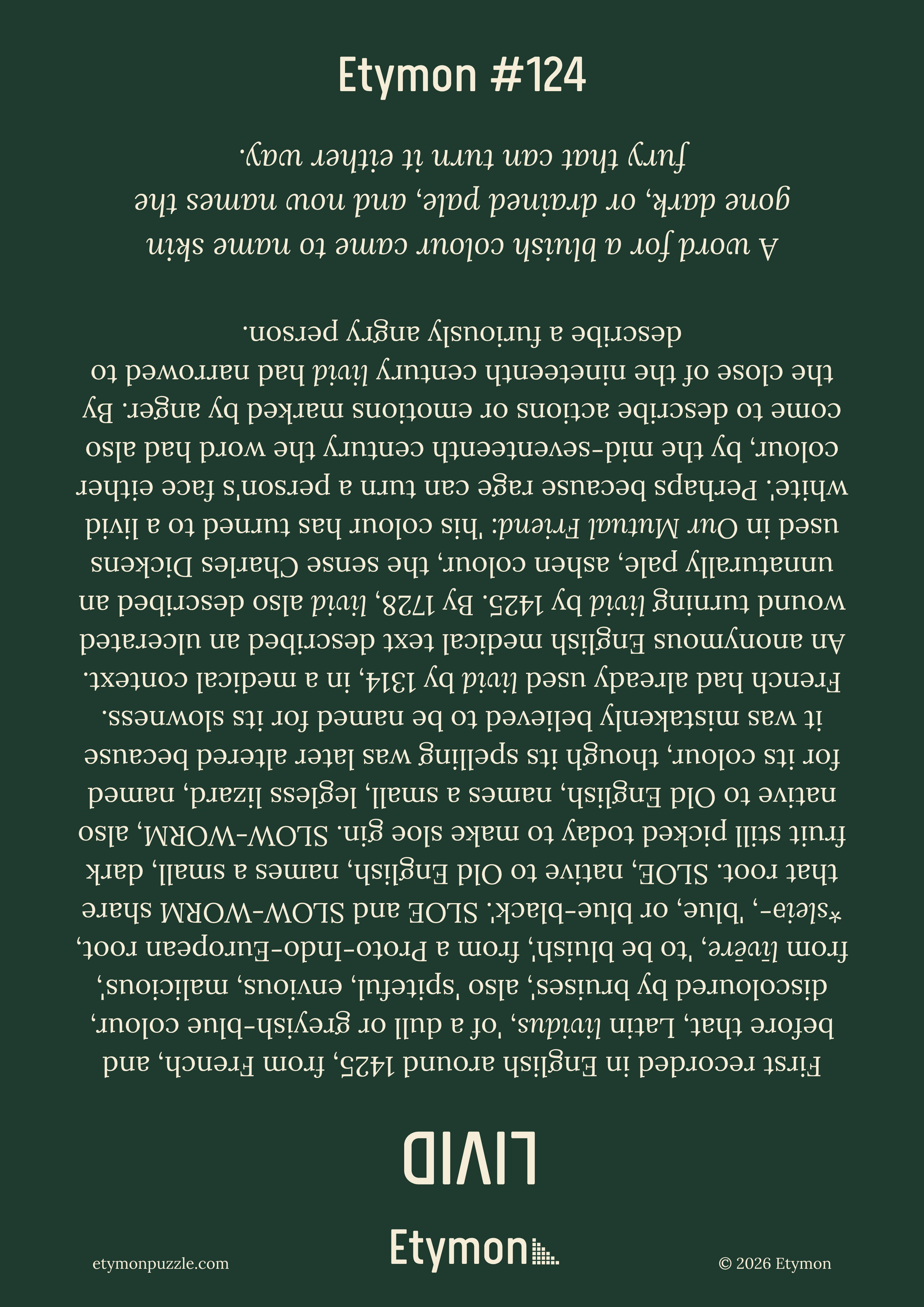
The word was first recorded in English around 1425, from French, and before that, Latin. An anonymous medical text used it to describe an ulcerated wound turning a bluish-grey colour.
French had already used the word by 1314, in a medical context. Behind the French form lay a Latin word that, from its earliest use, could also describe a person as spiteful, or envious.
Behind that Latin word lay a verb meaning 'to be bluish'. That verb traces to a Proto-Indo-European root, *sleiə-, meaning 'blue, or blue-black'. The same root gave Russian and Lithuanian their words for a plum, another fruit named for its dark colour.
SLOE and SLOW-WORM share the same root, meaning 'bluish, or blue-black'. SLOE is native to Old English, naming a small, dark fruit still picked today to make sloe gin. SLOW-WORM is also native to Old English, naming a small, legless lizard, named for its colour, though its spelling was later altered because it was mistakenly believed to be named for its slowness.
In 1425 the word already described dark discolouration, and by 1728, an unnaturally pale, ashen colour too. Charles Dickens used the word this way in Our Mutual Friend, describing a character whose colour had turned to white. Perhaps because rage can turn a person’s face either colour, by the mid-seventeenth century the word had also come to describe actions or emotions marked by anger. By the close of the nineteenth century it had narrowed to describe a furiously angry person.
Five letters.
Answer Card
Flip your screen to read the Answer Card.
Enjoyed today’s Etymon puzzle?
Get The Classical Word Collection free.
Ten Etymon puzzle cards exploring the Greek and Latin roots of English, yours when you subscribe free to Etymon.
Share your Solved in N
Share where you solved this Etymon puzzle on Substack Notes.
Find your relevant Solved in N banner above and tap the Restack button (the two circular arrows) in the banner’s top-right corner. Your banner will open automatically in a new Substack Note, ready to post. Add a comment if you like (please avoid posting the answer directly), then tap Post.
How did you get on?
Share how many clues you needed to solve this Etymon puzzle in the comments below.
To preserve the solving experience for future puzzlers, please avoid posting the answer directly. See full Commenting Guidelines.