How to play
Etymon is a daily puzzle about the origins of English words. Each day one word is hidden behind six clues drawn from its etymological history. Solve in your head if you can. Pencil and paper if it helps. After the six clues, an Answer Card reveals the answer, etymology, and the word’s life in modern English.
This page has two parts. The first explains how the puzzle works. The second covers how to solve it.
How it works
I. The six clues
Each Etymon puzzle has six clues with progressive narrowing toward the answer. The shape is consistent across puzzles. Once you’ve solved a few, you’ll know what to expect from each clue.
Clue 1: Era and origin. Where and when the word originated. Narrows the field without giving away the meaning.
Clue 2: Linguistic path. How the word travelled into English, through Latin, Greek, Old French, Old Norse, Old English, Arabic, or other source languages.
Clue 3: Literal meaning. What the root actually meant before becoming the modern sense.
Clue 4: Cognates. Two or three familiar English words connected to the puzzle word, through the same root, same source language, same moment of borrowing, or an ancient shared ancestor.
Clue 5: Historical or geographical context. A particular event, profession, period, place, or cultural practice the word came from.
Clue 6: Word length. Confirms or narrows between possible answers without revealing letters.
II. The Solved in N banner
Each clue is followed by its corresponding Solved in N tier banner. The banner serves two purposes.
First, it acts as a buffer between clues. Only one clue and its banner appear on screen at a time on phone, with slightly more on desktop. To see the next clue, you scroll past the banner. This keeps each clue separate, letting you sit with it before the next one arrives.
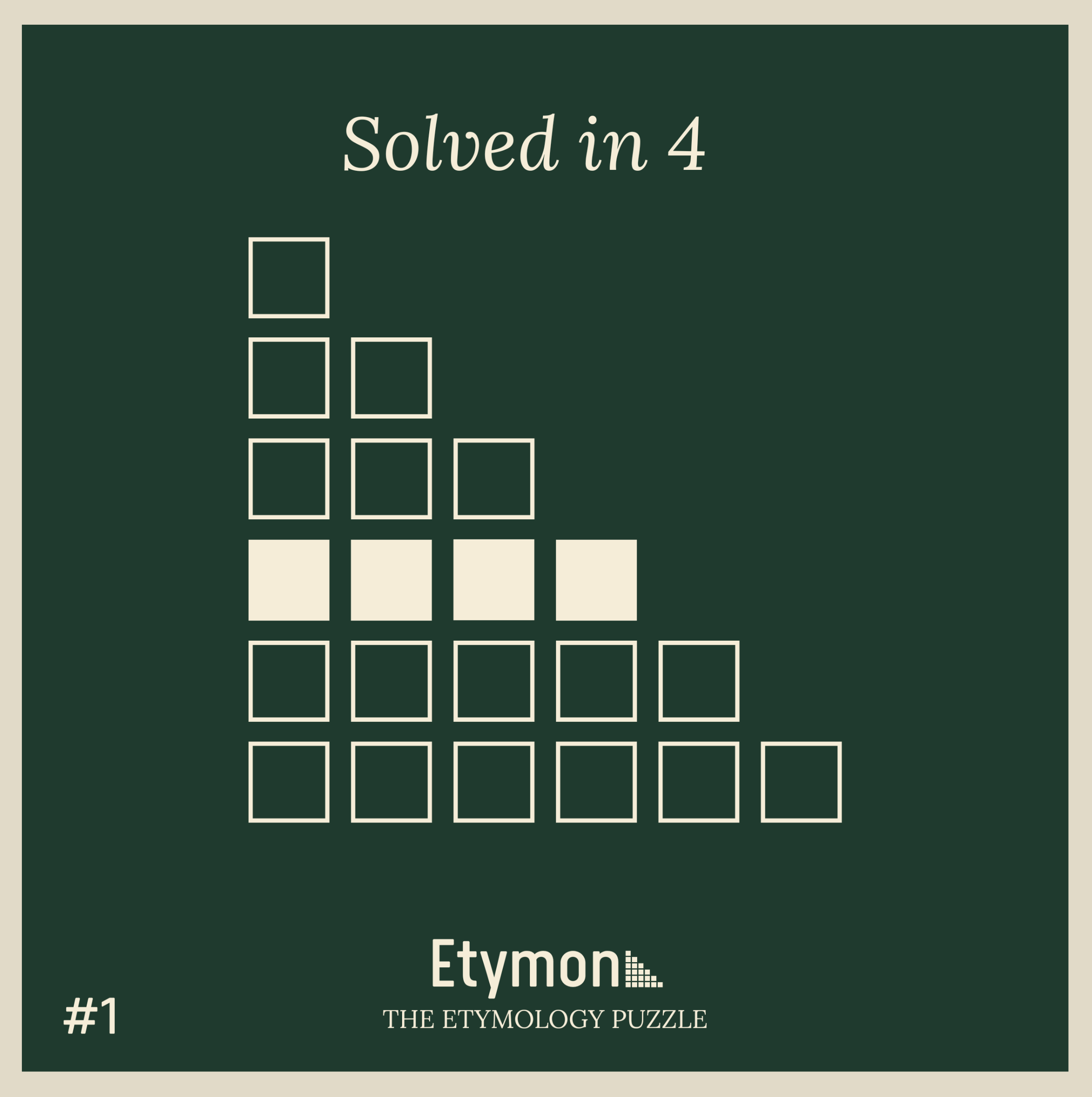
Second, the banner is the sharing graphic. If you solve at Clue 4, screenshot the Solved in 4 banner beneath Clue 4. The banner shows your Solved in N tier wherever the screenshot is shared, without revealing the clue or answer.
The banner uses a six-row pyramid with a single row filled cream marking the clue at which you solved. Solved in 1 fills the apex; Solved in 3 fills the third row; Solved in 6 fills the base. The full pyramid outline shows the puzzle’s structure; the filled row marks your moment of arrival.
This differs from the cumulative grids common across daily puzzle sharing, where each filled row represents a step taken. Etymon’s logic is different. The Solved in N text carries the cumulative narrative. The filled row marks where you arrived.
Every tier carries equal visual weight at its specific row. Solved in 6 is as much a part of Etymon as Solved in 1.
III. The Answer Card
The Etymon Answer Card is the puzzle’s reveal mechanic. Each puzzle page has an Answer Card download button at the bottom. Open the PDF to discover the answer, etymology, and the word’s life in modern English.
The Answer Card is yours to keep. The puzzle’s value isn’t in the answer alone but in the full etymological story, which the Answer Card delivers regardless of how many clues you needed.
IV. Sharing your Solved in N banner
The Solved in N banner is designed to be shared. After completing a puzzle, puzzlers can screenshot the banner, marking which clue revealed the answer.
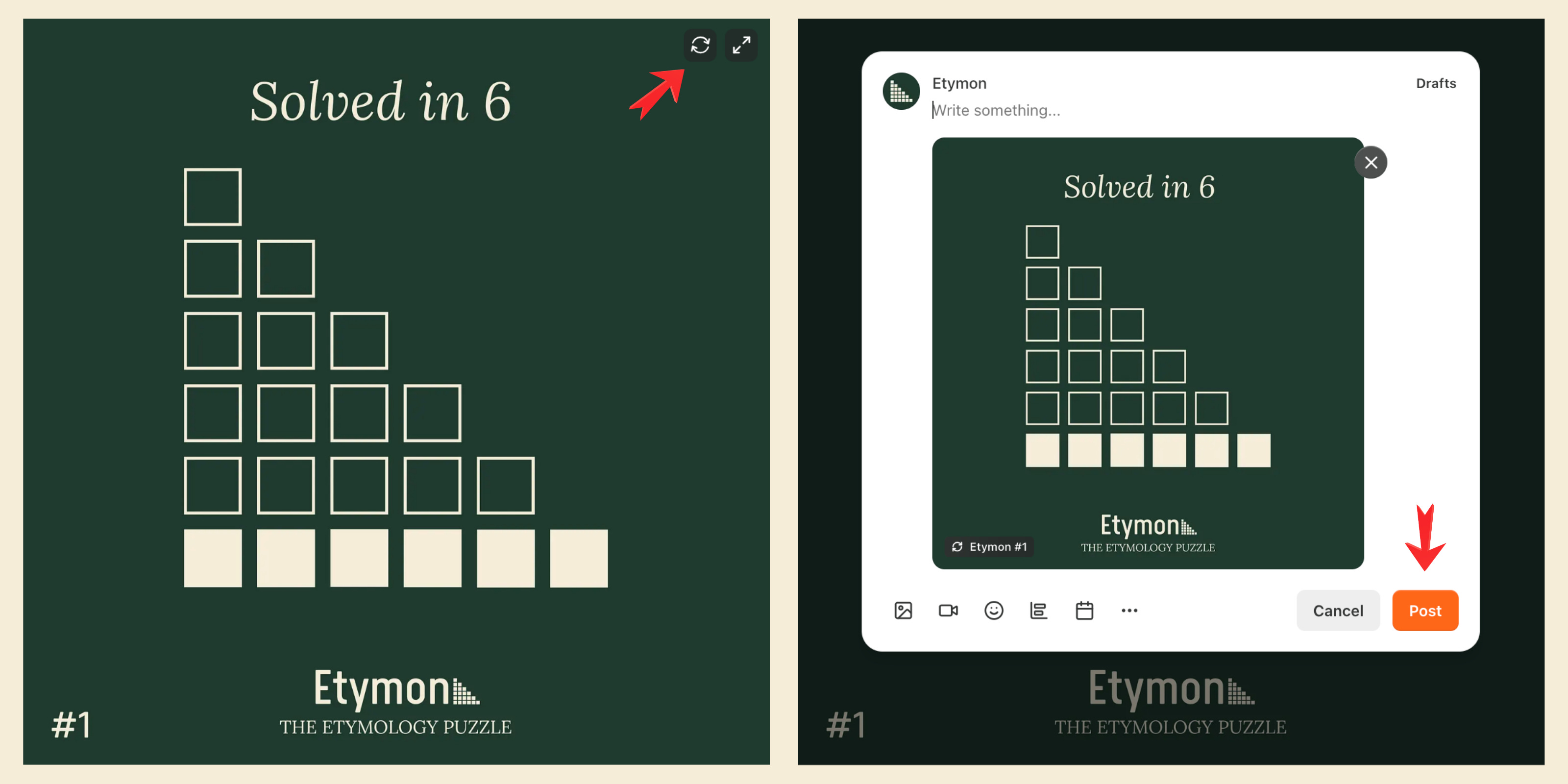
Substack Notes (Substack’s internal social feed) is a great place to share. Each puzzle page includes a Share on Substack Notes button at the bottom for posting your screenshot. Puzzlers sharing Solved in N screenshots can include #EtymonPuzzle so other puzzlers can find them.
Share the Solved in N tier banner only, not the clue, answer or Answer Card, so the puzzle isn't spoilt for other puzzlers. A portrait crop like the example below displays best in Notes.
V. Puzzle comments
The comments section at the bottom of the puzzle is a shared space for solving approaches, clue interpretations, historical observations, cognate discussions, and partial pathways through each puzzle.
Examples of helpful comments:
“Solved in 4, the cognates clicked it.”
“Still unsure after Clue 5.”
“Clue 3 shifted me toward Latin rather than Greek.”
To preserve the solving experience for future puzzlers, please avoid posting the answer directly.
Comments may be moderated to preserve the puzzle for future puzzlers. See the full Commenting Guidelines for more.
How to solve it
I. Crossword roots
Etymon draws from the crossword tradition, focused on a single puzzle word. The discipline of fair clues, the progressive narrowing, the contract between setter and solver. That contract means every clue gives the solver real evidence to reason from.
Three of Etymon’s six clue types have crossword equivalents. Three are original to Etymon’s etymological focus, including the cognate clue, which gives puzzlers two or three modern English words sharing the same root.
What Etymon doesn’t do is letter manipulation. The clues work on etymology, not letters. You reach the answer through reasoning about history, language, and cultural context, not through extracting letters from the clue.
Crossword experience helps but isn’t required.
II. What helps
Curiosity helps most. So does patience. Let the clues build up before settling on an answer.
Each clue adds evidence: the era and origin, the linguistic path, the literal meaning, the cognates, the historical or geographical context, the word length. Ideas form. Some narrow down; some fall away. By Clue 5 or 6 the field usually closes enough to commit.
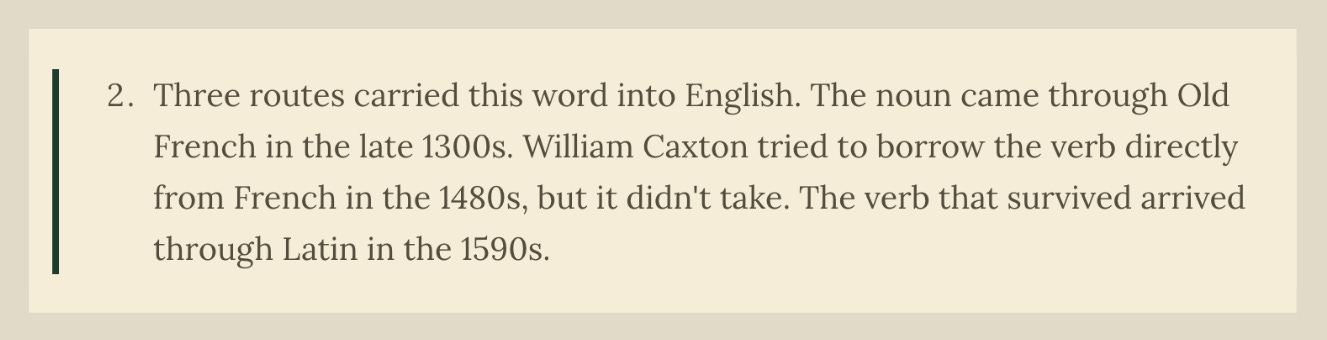
Take Clue 1 of Etymon #1. A Latin verb from the 1590s with a physical root meaning of looking down from a height. The field is wide: survey, overlook, observe, contemplate, spectate, maybe a dozen others. No need to commit. Clue 2 traces the verb through three routes (Old French, then Caxton’s failed French borrowing, then Latin). Clue 3 confirms the root means to watch, to observe. The candidates are all about looking, but several remain.
Clue 4 names Greek cognates: SCOPE, TELESCOPE, HOROSCOPE. The solver who knows the -scope words share a root for looking now has a clearer line. The answer is probably a Latin cousin of the same family. Words with spec- and -spect emerge.
By Clue 5’s late Georgian financial sense, the field has likely closed to one. Clue 6 confirms nine letters.
Most puzzles open up around Clue 4 or 5. Some yield earlier; some hold out longer. The Solved in N tier marks when the field closed for you.
III. What you already know
You probably know more etymology than you realise. Words ending in -tion often come from Latin. Words starting with psy- or phil- come from Greek. Lots of short common words (HOME, WORK, FOOD, KING) come from Anglo-Saxon. Words about food, courts, and law often come from Old French, brought over by the Normans.
These patterns narrow your guesses. If Clue 1 mentions Rome or Latin learning, the answer probably came through Latin. If it mentions medieval England's nobility, probably Old French. If it mentions ancient Greece, Greek (though sometimes via Latin).
IV. Layers of English
Modern English is layered.
Anglo-Saxon foundation (everyday words: HOME, BREAD, MOTHER, EAT).
Latin scholarly inheritance (formal vocabulary: TRANSLATE, CONTEMPLATE, PROFOUND).
Old French aristocratic borrowing after 1066 (BEEF, COURT, PARLIAMENT).
Greek scientific and philosophical borrowing (PHILOSOPHY, BIOLOGY, DEMOCRACY).
Plus borrowings from many other sources: Old Norse from Viking settlement (SKY, EGG, LAW), Arabic via mathematics and trade (ALGEBRA, COTTON), Hindi via empire and colonial vocabulary (BUNGALOW, SHAMPOO), German via philosophy and science (KINDERGARTEN, ZEITGEIST), Italian via Renaissance arts and music (OPERA, BALCONY), Spanish and Portuguese via exploration and the Americas (TOMATO, BANANA), Dutch via trade and the sea (YACHT, COOKIE), Sanskrit via classical Indian texts (KARMA, GURU), and Celtic via the British Isles (WHISKY, CLAN).
When solving, ask which layer the puzzle is operating in. The clue usually signals this through period and context.
V. Working with cognates
Cognates are modern English words connected to the puzzle word through shared etymological history. The connection can take several forms, and the cognate clue draws on all of them.
Same root. Two or three modern English words descended from the same source root. DENTAL and DENTIST are cognates (both from Latin dens, tooth). PENSIVE and PENDANT are cognates too (both from Latin pendere, to weigh, to hang), though the connection is less obvious. The shared root isn’t always visible in modern spellings, but the etymology connects them.
Same source language. Two or three modern English words borrowed from the same source language, even when they trace back to different roots within that language. ZENITH, NADIR, and AZIMUTH are cognates of this kind: all three came into English from Arabic during the medieval period, when European astronomers drew on Arabic astronomical scholarship, but each carries a different Arabic root. The shared signal is the source language and the period of borrowing.
Same moment of borrowing. Two or three modern English words borrowed from the same historical moment, often a specific encounter or event. BEEF, PORK, and MUTTON are cognates of this kind: all three entered English from Norman French in the centuries following the conquest of 1066. English kept the older Anglo-Saxon words for the live animals: cow, pig, sheep. The Norman words named the meat on the table. The shared signal is the historical moment that brought the words into English together.
Ancient shared ancestor. Two or three modern English words connected through a very deep root, reaching English through different language families. HEART, CARDIAC, and CORDIAL are cognates of this kind: all three trace back to an ancient root meaning “heart,” but HEART reached English through the Germanic branch, CARDIAC through Greek, and CORDIAL through Latin. The connection is genuine but ancient, and the modern senses have travelled far apart.
Working back from cognates to the connection is the technique the clue invites. The puzzler’s job is to ask: what do these two or three words share? The shared element might be a visible root, a source language, a historical moment, or an ancient ancestor reaching English through different paths.
VI. Improving over time
Solving Etymon puzzles regularly produces cumulative benefit. Each puzzle teaches one specific etymology. Across months and years, accumulated knowledge means later puzzles get easier, not because the puzzles are simpler but because you’ve absorbed more etymology.
Puzzlers who engage consistently across a year will find their solving improves. Patterns become visible. Source languages become familiar. The cognate technique becomes second nature.
VII. However you finish
The Solved in N mechanic acknowledges full engagement. Solved in 6 is genuine completion of the puzzle’s full ladder. Solved in 1 is exceptional. Every tier is part of the experience.
If you’ve worked through all six clues and still can’t reach the answer, that’s fine. The Answer Card rewards whether you solve it or not.